
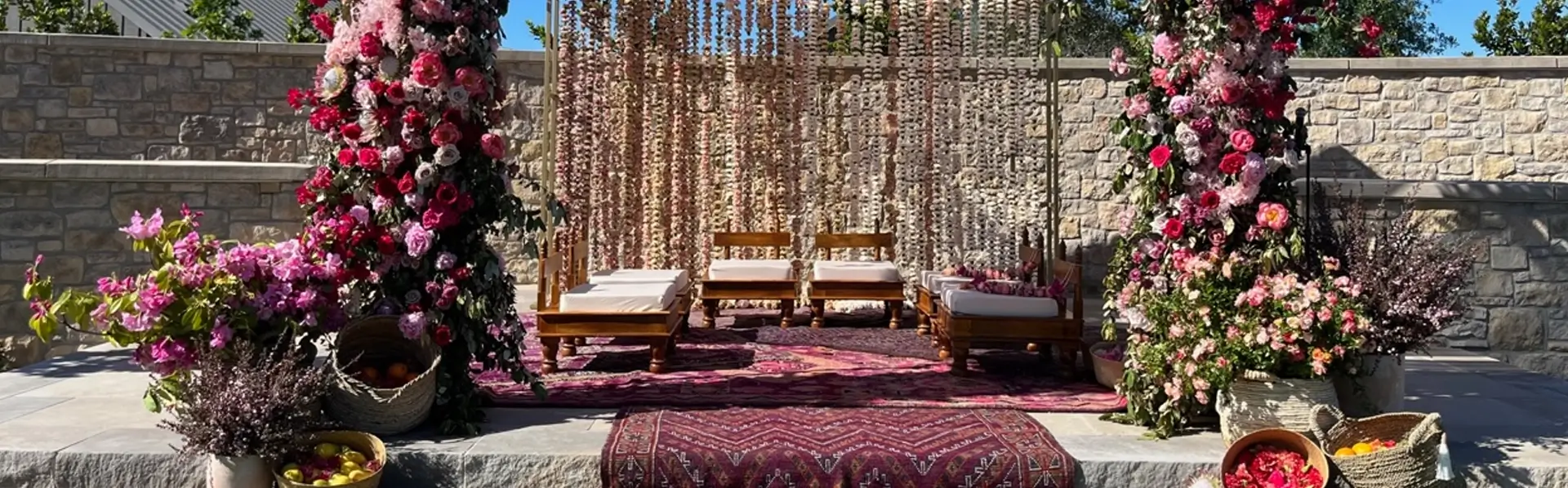
An Indian wedding often begins long before the principal ceremony. Mehndi, Haldi, and Sangeet celebrations bring families and friends together through artistry, blessings, music, dance, food, and shared traditions. Although these events may take place during the same wedding week, each has its own atmosphere and practical décor needs.
Thoughtfully selected rentals can help each occasion feel distinctive while maintaining a cohesive design across the entire celebration. The most successful settings support what guests will actually do, whether they are receiving henna, participating in family rituals, watching performances, dancing, dining, or gathering for photographs.
The names, customs, order, and formality of pre-wedding events vary among regions, religions, and families. A Punjabi Sangeet may be planned differently from a Gujarati Garba, while Haldi customs and Mehndi traditions may also differ. Décor should never assume that every Indian wedding follows one standard format.
Before selecting rentals, ask the couple and family which rituals will take place, who will participate, what items must be accommodated, and whether certain colors, symbols, or materials have personal or cultural importance. This conversation allows the design to honor family practice while still reflecting the couple’s style.
The Mehndi celebration is often social, artistic, and relaxed. Guests may spend considerable time seated while henna is applied, talking with family, enjoying refreshments, and taking photographs. Comfortable furniture and a practical layout are therefore as important as color and decoration.
Low seating, upholstered benches, diwans, pillows, rugs, poufs, coffee tables, and carved accent furniture can create intimate gathering areas. A jhula may serve as a beautiful focal point for the bride or couple when it suits the family’s plans. Textiles, umbrellas, lanterns, brass pieces, floral details, and patterned backdrops can add warmth without making the space difficult to navigate.
A henna station should provide appropriate seating for the artist and guest, useful lighting, a nearby surface for supplies, and enough room for people to enter and leave without disturbing the work. If several artists are present, the layout should prevent lines from blocking lounge areas, food service, or major walkways.
Small tables, trays, washable coverings, cushions, and directed lighting can make the station more comfortable and organized. Decorative framing, flowers, textiles, or a modest backdrop can distinguish the area while allowing the henna artists to work efficiently. Couples should confirm the artists’ space and lighting requirements before the final floor plan is approved.
One well-designed focal area can give the Mehndi visual identity and provide a natural setting for photographs. This may include a jhula, carved sofa, colorful textile backdrop, floral arch, collection of lanterns, or grouped vintage Indian pieces. The focal point should be properly scaled to the room and positioned where guests can approach it easily.
Repeating selected colors or materials elsewhere through pillows, table accents, umbrellas, or floral arrangements can connect the focal design to the rest of the venue without duplicating it at every table.
The Haldi ceremony is joyful and visually distinctive, but turmeric preparations can stain fabric, upholstery, rugs, clothing, and nearby surfaces. Décor planning should account for how the ceremony will unfold and where the mixture, water, flowers, and family members will be positioned.
Use an appropriate chair, bench, low seat, or platform that can be protected and cleaned according to the rental agreement. Washable floor coverings, trays, bowls, low tables, and clearly defined ceremony boundaries can help contain the activity. Delicate textiles, irreplaceable antique pieces, and absorbent upholstery should not be placed where staining is likely.
Yellow is closely associated with many Haldi celebrations, but it does not need to be the only color in the design. Marigold tones, saffron, orange, green, fuchsia, ivory, and natural wood can create depth and contrast. Floral strings, baskets, brass bowls, umbrellas, fabric panels, and modest backdrops can form an inviting setting that remains practical for the ceremony.
The article on color and symbolism in Indian weddings offers additional guidance for creating a palette that respects tradition and suits the venue.
Haldi is rarely a static photo opportunity. Relatives may approach the seated participant, present items, offer blessings, apply turmeric, and gather closely around the ceremony. The layout should leave enough open space for movement and should not surround the principal seat with fragile objects or closely spaced decorative pieces.
Photographers also need useful sightlines. A beautiful backdrop is most effective when the activity in front of it can unfold naturally and safely. Discuss the expected number of participants and any processional or family traditions before positioning rentals.
The Sangeet frequently includes speeches, dances, live music, family performances, and formal entrances. Its stage and backdrop must function as performance infrastructure as well as décor. Confirm stage dimensions, performer count, choreography, musical equipment, screens, stairs, backstage access, and the relationship between the stage and dance floor.
An elaborate backdrop should not reduce usable performance space or interfere with lighting and sound equipment. Likewise, stage furniture should be placed where it supports planned moments without becoming an obstacle during dances. The planner, entertainment team, and décor company should review the layout together.
Lighting can transform the Sangeet from dinner and performances into an energetic dance celebration. Stage lighting, uplighting, warm ambient fixtures, lanterns, and focused illumination for entrances or speeches can create distinct moods throughout the evening. Lighting colors should complement clothing, skin tones, photography, and the principal décor palette.
Electrical access, cable routes, sound equipment, and venue restrictions should be confirmed early. Our guide to using lighting to enhance Indian wedding celebrations explains how traditional and modern lighting can work together.
Not every guest will remain at a dining table or on the dance floor throughout the evening. Lounge groupings provide comfortable places for older relatives, families, and guests to converse while remaining connected to the entertainment. Sofas, diwans, chairs, ottomans, pillows, rugs, and small tables can define these areas.
Lounge furniture should not obstruct performance views, service paths, or dance-floor access. Several appropriately positioned groupings often work better than one large arrangement that separates guests from the celebration.
Mehndi, Haldi, and Sangeet décor can be distinctive without appearing unrelated. A shared color family, repeating textile, coordinated metal finish, or collection of cultural pieces can connect the events. The styling can then evolve from an intimate daytime Mehndi to a practical and joyful Haldi and finally to a dramatic evening Sangeet.
This approach gives the wedding weekend a recognizable visual identity while allowing each celebration to retain its own character. It may also permit certain rentals to be used more than once when timing, transportation, condition, and labor make a transition practical.
Reusing furniture or decorative pieces can be efficient, but the decision must account for event schedules and cleaning requirements. A sofa used during Mehndi may be suitable for a Sangeet lounge, while a Haldi ceremony seat exposed to turmeric may require separate protection, cleaning, or replacement before another event.
Moving décor between rooms or venues involves breakdown, transportation, setup, and styling. Ask whether the proposed reuse actually reduces costs once labor and timing are considered. Our guide to Indian wedding décor rental costs in California explains how multi-day resets and delivery affect a proposal.
Pre-wedding events may take place at private homes, hotel ballrooms, gardens, vineyards, restaurants, or separate event venues. Each setting has different access, noise, flame, electrical, installation, parking, and breakdown requirements. Home celebrations may also require careful planning for furniture movement, flooring protection, neighborhood restrictions, and guest circulation.
For outdoor events, consider sun, wind, temperature, shade, evening lighting, and a weather backup location. Fragile backdrops, loose fabrics, umbrellas, floral strings, and lightweight accessories should be selected and installed with the conditions in mind.
The décor company should receive the complete schedule rather than isolated start times. Include venue access, vendor arrivals, ceremonies, performances, room changes, photography, guest entry, event completion, and required breakdown. This is especially important when several celebrations take place within a short period.
A complete schedule allows the team to determine whether inventory can move between events, whether additional staff or vehicles are needed, and how much time is available for styling. The California Indian wedding checklist can help couples organize the rentals needed throughout a multi-day celebration.
Bring the date, venue information, estimated guest count, event schedule, floor plans, performance requirements, family traditions, preferred colors, and inspiration photographs to the consultation. Identify which rentals are essential and which ideas are flexible. If henna artists, musicians, choreographers, caterers, or other vendors have specific space requirements, include those details as well.
Clear priorities help the décor team recommend pieces that serve the celebration rather than adding decoration without purpose. Couples should also ask what is included in delivery, installation, room transitions, breakdown, cleaning, and venue coordination.
Mehndi, Haldi, and Sangeet celebrations are connected, but they should not look or function exactly alike. The Mehndi may feel intimate and artistic, the Haldi bright and joyful, and the Sangeet theatrical and energetic. Rentals, color, lighting, and layout can support those differences while preserving a cohesive wedding-week design.
With culturally informed planning and practical attention to how guests will use each space, these pre-wedding events can become some of the most personal and memorable parts of an Indian wedding in California.